



A big thank you to our sponsors.
Because of them, Sajha stays free for every member of the community.
Click here to view our sponsors →Bhagavad Gita: The Most Powerful Lessons for Life

The Bhagavad Gita (भगवद् गीता) is a 700-verse Hindu scripture within the Mahabharata. It presents a conversation between Krishna and Arjuna on a battlefield.
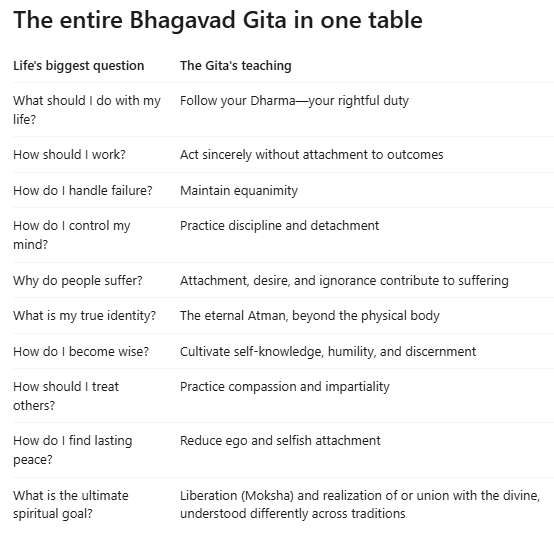
But its deeper subject is not war. It is how to live, make difficult decisions, understand yourself, and find inner peace in a world full of uncertainty.
Here are the 10 most impactful teachings I believe everyone should understand.
10 life-changing lessons from the Bhagavad Gita
1. Focus on your actions, not the results
Chapter 2, Verse 47
You have control over your actions, but not complete control over their outcomes.
Life lesson: Do your best without becoming emotionally dependent on success or failure.
This does not mean ignoring results. It means not allowing your happiness to depend entirely on them.
2. Your mind can be your greatest friend or enemy
Chapter 6, Verses 5–6
A disciplined mind can support your growth, while an uncontrolled mind can work against you.
Life lesson: Learn to manage your thoughts, emotions, and reactions instead of letting them control you.
3. Nothing in life remains unchanged
Chapter 2, Verses 13–14
The body changes through childhood, youth, and old age. Pleasure and pain also come and go.
Life lesson: Don't become so attached to temporary circumstances that you lose your inner stability.
4. Anger can destroy good judgment
Chapter 2, Verses 62–63
The Gita describes a progression from attachment to desire, anger, confusion, and the loss of sound judgment.
Life lesson: Don't make important decisions when anger or obsession is controlling your thinking.
5. Do what is right, even when it is difficult
Chapter 3, Verse 19
The Gita emphasizes performing necessary actions without selfish attachment.
Life lesson: Responsibility and integrity matter more than convenience.
However, determining what is right may itself require careful reflection.
6. Success and failure should not define your worth
Chapter 2, Verse 48
Krishna teaches Samatva—equanimity in success and failure.
Life lesson: Celebrate success without arrogance and face failure without losing confidence.
7. Desire without limits creates suffering
Chapter 3, Verses 37–43
Uncontrolled desire and anger are portrayed as powerful obstacles to wisdom.
Life lesson: Ambition is useful, but endless craving can make satisfaction impossible.
8. True wisdom includes humility
Chapter 13, Verses 7–11 in some editions
Humility, nonviolence, patience, sincerity, and self-discipline are described as qualities associated with knowledge.
Life lesson: Being intelligent is not the same as being wise.
9. You are more than your physical body
Chapter 2, Verses 20–22
The Gita teaches that the Atman (self) is unborn and does not perish when the body dies.
Life lesson: In the Gita's spiritual worldview, identity extends beyond physical existence.
This is a religious and philosophical teaching, not a scientifically established fact.
10. Inner peace comes from reducing ego and attachment
Chapter 2, Verse 71
Krishna describes peace as arising when a person abandons possessiveness, egoism, and compulsive craving.
Life lesson: Peace does not necessarily come from having everything you want. It may come from needing less to feel complete.
Three teachings I consider the most valuable
BHAGAVAD GITA 2.47
Control your effort, not the outcome.
You can prepare, work hard, and make good decisions. But you cannot control every result. Focus on what is within your influence.
BHAGAVAD GITA 2.48
Remain steady in success and failure.
Don't let praise inflate your ego or criticism destroy your confidence. Emotional balance is a form of strength.
BHAGAVAD GITA 6.5
Master your mind before it masters you.
Your reactions, habits, and thoughts influence your quality of life. Self-discipline creates greater freedom.
What is the deepest message of the Gita?
Arjuna faces an impossible moral dilemma. He does not want to fight people he loves and respects.
Krishna does not simply tell him to pursue happiness or avoid suffering. He challenges Arjuna to understand his duty, the nature of the self, and the consequences of attachment.
The Gita also teaches devotion (Bhakti Yoga), knowledge (Jnana Yoga), and disciplined action (Karma Yoga) as interconnected spiritual paths.
Its central message can be summarized as:
Live with purpose. Act with integrity. Control your mind. Let go of excessive attachment. Recognize something greater than your ego.
And perhaps the most useful lesson for modern life is this:
You cannot always control what happens around you, but you can develop greater control over how you respond and what you choose to do next.





-
Looking for Hair Stylist FeaturedArlington, MA ·
-
Gainesville, TX ·
-
Employees Needed FeaturedBoston, MA ·
-
Job at Smoke shop FeaturedEverett, MA ·
-
Boston, MA · Reposted
-
 Big Room with Parking Next to bus stop USD 1,100.00Everett, MA · Reposted
-
 Room Available for Rent USD 850.00Melrose, MA · Reposted
-
 Malden, MA · Reposted
-
Centreville, VA ·
