



A big thank you to our sponsors.
Because of them, Sajha stays free for every member of the community.
Click here to view our sponsors →“There was a time when we equated Nepali nationalism with anti-India sentiment. That era is now over.”
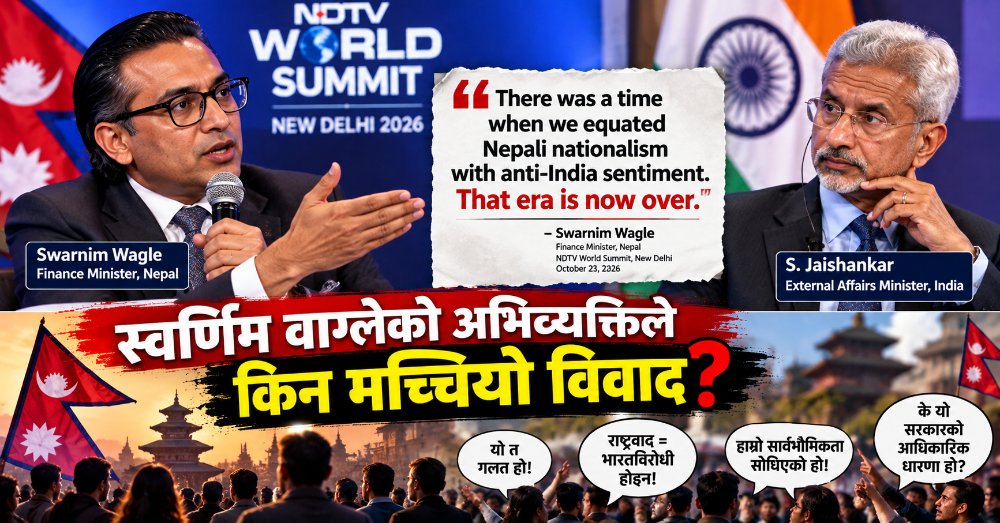
Nepal's Finance Minister Swarnim Wagle sparked controversy during the NDTV World Summit in New Delhi on October 23, 2026, with a statement about Nepali nationalism and India.
What exactly did he say?
His most controversial statement was:
“There was a time when we equated Nepali nationalism with anti-India sentiment. That era is now over.” NDTV
In Nepali:
“कुनै समय नेपाली राष्ट्रवादलाई भारतविरोधी भावनासँग जोडेर हेरिन्थ्यो। तर अब त्यो युग समाप्त भएको छ।”
He also made several other remarks:
- Nepal and India are deeply connected geographically, culturally and historically.
- Nepal's younger generation wants jobs, economic prosperity, good governance and friendly relations with India.
- India's economic growth could create opportunities for Nepal.
- Nepal's new leadership wants to improve relations with India. The Kathmandu Post +1
What did he say to India's foreign minister?
At the summit, Wagle also addressed Indian External Affairs Minister S. Jaishankar, praising examples Jaishankar had given of India's contributions in areas such as yoga, nutritious grains, solar energy and disaster response.
However, the statement that generated the biggest controversy was made during Wagle's broader summit discussion, not necessarily as a direct remark to Jaishankar.
Nepal's First Online News Portal
Why are so many Nepalis upset?
The central disagreement is about what Nepali nationalism means.
Critics argue that Wagle's statement makes it sound as though Nepali patriotism has historically been based on hostility toward India.
Former foreign minister Kamal Thapa and other political figures objected, arguing that opposing Indian policies concerning border disputes, blockades or cross-border flooding is not the same as being anti-India.
They also questioned whether Wagle was presenting his personal interpretation or the Nepal government's official position.
Was his statement taken out of context?
There is an important distinction.
Wagle's broader argument was that Nepal should move beyond confrontational nationalism and focus on economic cooperation without abandoning its sovereignty.
In an earlier interview, he had indicated that Nepal would still raise difficult issues, including border disputes, but seek constructive solutions.
Nepal's First Online News Portal
His critics, however, maintain that his choice of words unfairly characterizes legitimate Nepali concerns as anti-Indian sentiment.
The controversy essentially comes down to one question:
Does improving Nepal–India relations require moving beyond anti-India rhetoric, or does describing past Nepali nationalism that way undermine legitimate concerns about Nepal's sovereignty?
You can read the NDTV coverage of Wagle's original remarks for more context.

-
Arlington, MA ·
-
Gainesville, TX ·
-
Employees Needed FeaturedBoston, MA ·
-
Job at Smoke shop FeaturedEverett, MA ·
-
Boston, MA · Reposted
-
 Room Available for Rent USD 850.00Melrose, MA · Reposted
-
 Malden, MA · Reposted
-
Centreville, VA ·
-
 Malden, MA · Reposted
